Feeds:
Posts
Comments

Archive for the ‘Western Excursion’ Category

DSC_0156  The breakfast was completed and the tour north began in earnest. We would soon be witnessing the beauty of the Grand Teton Mountain range! We left the famous Jackson Hole area of western Wyoming.                                    DSC_0160

Jackson, also, known as Jackson Hole  is a tourist community. Everything one sees in geared towards the tourism economy. Those high forested hills that surround the town are stunning too. Looking backwards from where we stayed we could see ski lifts.  Winter is big in this area too!                                                                     DSC_0146

Laurie and I watched as two hand gliders leapt from the top to begin floating about the sky. The evening before we watched a cowboy shoot out.

We were thrilled once the sight of the Grand Tetons was visible! We were in unbelief upon viewing the spectacular mountains. We found taking our eyes off of them to be difficult. Photos just can not show the grandeur of such things of nature! The only negative thing, I can think of,  was the fact of a slight haze due to distant forest fires. Many fires were west of us in nearby Idaho. The haze reminded me of a humid condition here in good old Pennsylvania.                                                          IMG_1158

The 310,00 acre national park was established in 1929. (I was just a boy then.) The park’s size was increased in 1950. The highest elevation is of the Grand Teton mountain at 13,770 feet. Snow from last winter, and spring, was still visible at certain places amid the rocky outcrops.                                IMG_1167

Chapel of the Transfiguration

Chapel of the Transfiguration

Other named peaks include: Mount Moran at 12,605 feet; Mount Owen at 12, 928 and South Teton at 12, 514 feet. People do climb the mountains and injuries are common, as well as, some deaths. Trails exist on and around the peaks too.

Raven (note large beak)

Raven (note large beak)

The clear waters of the Snake River flow through the lands. Several lakes are present too. We saw Jackson Lake and Jenny lake. (More on the Snake River under a separate entry.)

Many species of wildlife are present in the Grand Teton area. We saw a lot of wildlife while touring and floating the Snake River.

Aspens

Aspens

Bison!

Bison!

We saw a number of bison (buffalo) in open areas. Someone shouted “BEAR” and we turned to get a brief glimpse of a young grizzly bear! Ravens were common. I was tolerated by one. I managed a few great shots of this raven. Other species in the area are elk and mule deer. I saw a Mountain Bluebird and, of course some pronghorn antelopes. I saw both of these species. Wolves are surviving here too. I would have loved to see some wolves!                                             DSC_0180

Bison will cause more injuries than any other species of wildlife here. It is no wonder! I saw some people try to get very close. These people would NOT have been able to escape if these big mammals decided to charge. State law forbids anyone from getting closer than 25 yards. We were told of one lady who was told to get back from bison because of the potential danger. She became angered exclaiming how dare they allow dangerous animals in the park….. DUH!! These are wild animals not a zoo! Other interesting sites included a small log church known as the Chapel of the Transfiguration. (In fact a wedding was occurring at this church.)  We visited a small rural old-fashioned store. I bought some huckleberry honey! We saw remnants of an old ferry known as Menor’s Ferry.      DSC_0247

Much of this area close down by mid-November due to snow. the snow may be present into May and even early June.

IMG_1162

Read Full Post »

IMG_1143  The vast prairie lands are visible in a 360 degree field of view. All directions are covered with the pale-blue sage brush and white-colored rocks and ground. The sight is magnificent to behold to a couple of easterners. The sage sends down deep tap roots and then lesser roots parallel to the surface. Some of these plants may be over a hundred years old.

Close-up of a sage specie

Close-up of a sage specie

IMG_1140

The trail is now headin’ north as we approach the area known as Jackson Hole. The unbelievable mileage of flat sage-covered land is mind-boggling.   We did see a couple of Prairie Falcons and more antelopes.

Wild horses in a corral.

Wild horses in a corral.

Wild Horses

Wild Horses

In this area of Wyoming are living wild horses. The location is north of the community of Rock Springs, The buttes and vistas are home for approximately 2500 wild horses. A thriving population is surviving on these barren lands. Those in the know make claims the horses grow by 20% and up to 40 % annually. Reproduction is, apparently, going well for the horses.

Prickly Pear Cactus (Note insects)

Prickly Pear Cactus (Note insects)

With that in mind a number of wild horses are taken into corrals periodically in an effort to maintain a stable herd number. We stopped at one such corral.

The horses are placed up for adoption while in captivity.                                                                              DSC_0031

IMG_1146  Eventually, as we continued north, we began to see higher terrain again and some steep and grandeur mountains were present prior to our descending into Jackson Hole. The hollow featured clear mountain waters flowing towards the Snake River. I was blessed to briefly see a Bighorn Sheep ram. The ram was a younger one since he lacked the full-curl horns.    DSC_0038

Read Full Post »

DSC_0059   The terrain changes rapidly in many areas of our travels. We are seeing lush farm country lands of Nebraska and suddenly we are witnessing prairie lands pale blue with sage brush and rocky outcrops. This day brought about our first view of the “true west” country.

The place we stayed in Cheyenne

The place we stayed in Cheyenne

DSC_0117

We stayed in Cheyenne, Wyoming and later moved through Laramie. Obviously, I remember these names from western history and old western television shows.                                        DSC_0080

DSC_0096 In southern Wyoming steep hills become more prevalent in certain areas. These were the Laramie Mountain ranges of the Medicine Bow National Forest. We were impressed with their stature, but the mountains of our future would dwarf these ridges.

Big Sky

Big Sky

We traveled across this area when suddenly we emerge in a vast basin going on for miles. We were impressed! The sage country was now in full view. We were in a very unique and beautiful land.

A sage

A sage

The very common sages are unique plants. They tend to have a pale bluish hue. The plants have a remarkable and pleasant aroma when rubbed between the fingers. Sage was used by the Indians and early settlers as a deodorizer. These people might rub some on their bodies and place in their abodes to help as a freshener.     DSC_0077

Blue Prairie Flax

Blue Prairie Flax

We stopped at a visitor center or two. I noticed a small, pale “groundhog-like” mammal. They were known locally as a pocket gopher. The correct name is Uinta Ground squirrel. Laurie was fascinated with them and we managed to get close enough to observe them and take  photos. They were cute little rascals, but by the amount of ground piled up I could see they could be damaging to property.

Uinta Ground squirrel

Uinta Ground squirrel

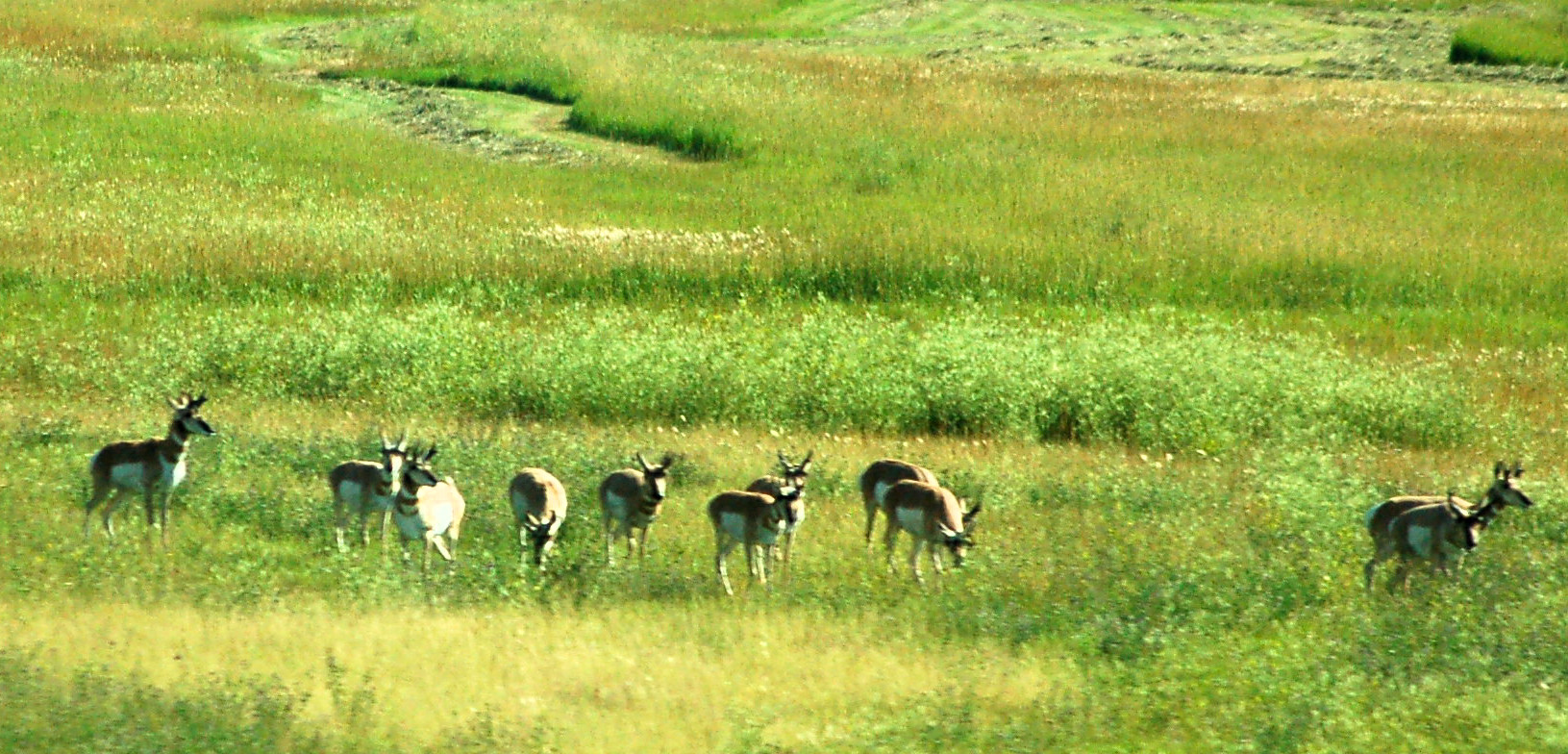
Sage brush was very common by this time of our travels. Miles of the plants were everywhere. This was a strange beauty. Pronghorn antelopes became routine. We saw hundreds of them. Most would be over two hundred yards from the roads with few exceptions.

DSC_0101

Pronghorn Antelopes

Pronghorn Antelopes

Read Full Post »

DSC_0006   Westward Ho the Wagons was a 1956 film  depicting pioneers heading west during the difficult and dangerous times after the Civil war.  Laurie and I heard the words “Go West Young Man”. These were words accredited to Horace Greeley after that great war.

Hundreds of windmills are located in the flatter states.

Hundreds of windmills are located in the flatter states.

We began our western journey on August 11 during the wee hours of the morning. The western migration had begun with many planned destinations in store for us weary pilgrims. The wagon axles were greased and the horses strong!

DSC_0010  The areas we were to visit included such, well-known, places as Jackson Hole; the Grand Tetons; Yellowstone; the Black Hills; the Badlands and many other interesting and enjoyable events. We saw a rodeo in Cody, Wyoming; a wild horse area; museums and much of western America’s varied and diversified lands.                                              IMG_1534

(I will be including many entries of this trip over time with many photos since I have taken , at last, count 1049 photos. They will be titled and numbered. This, of course is number 1.)                  

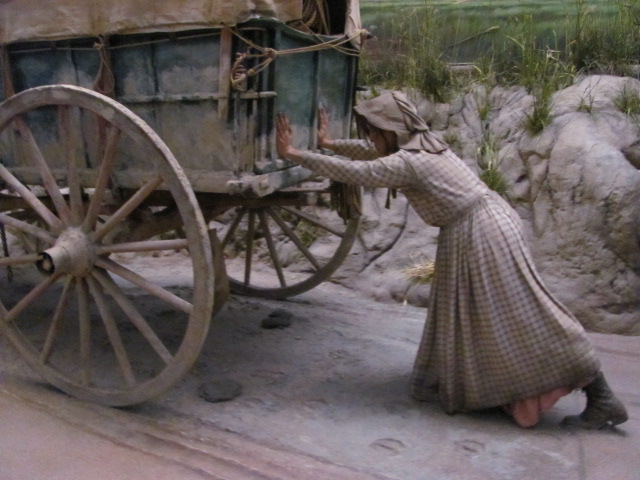
A hard and difficult way of life!

A hard and difficult way of life!

Early pioneers with Conestoga wagon.

Early pioneers with Conestoga wagon.

The reason for this excursion came about after much discussion. We are seeing much uncertainties with the health bill that was passed. We, too, are uncertain of our health insurance’s status in the years to come. We have, already, since increases and changes with Laurie’s plan. We decided “the heck with it” and elected to move out!

The travel through the states of Ohio and Indiana into Illinois were the “Agricultural flatlands” of the first day. Of course, this terrain is not what I am used to seeing. The contrast is stark from my beloved Pennsylvania hills and hollows. Yet, despite this variance they land is still beautiful.

DSC_0015      We settled in the first evening at Peru, Illinois. The following morning we visited “Boy’s Town” in Omaha, Nebraska. We toured the magnificent church and Father Edward Flanagan’s home and other sites. Spencer Tracy and Mickey Rooney starred in a film of the same name in 1938. The home was started by the father to aid delinquent and underprivileged boys. The intent was to correct these boys and make them into productive citizens. The web site is: www.boystown.org

The trail continued throughout Nebraska. All I can say about Nebraska is CORN AND MORE CORN! Corn, and other crops, could be viewed for as far as the eye can see. Hundreds of acres of agricultural crops!  One can realize why the mid-west states are called the “Breadbasket of America.”                                                                                                          

Great Platte River Archway

Great Platte River Archway

Mountain man searching for a woman.

Mountain man searching for a woman.

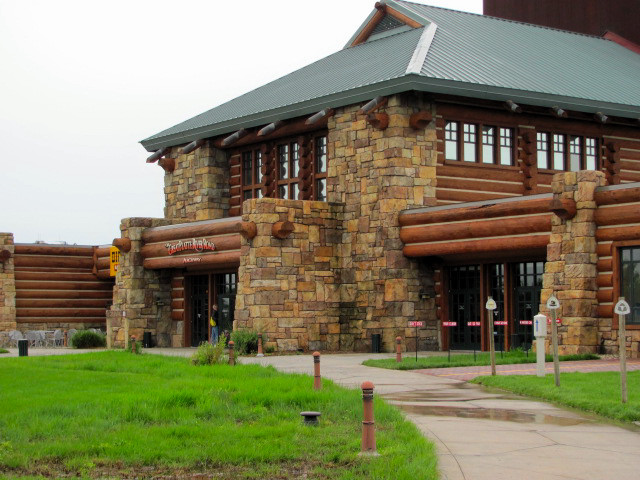
We, also, stopped at the award-winning, Great Platte River Archway Monument. This construction completely covers Interstate 80 and has many exhibits of history of the early pioneer days through the more modern era. This is in regards to Highway 30 or the Lincoln Highway. This year is the 100th anniversary of the Lincoln Highway. This road travels through most of Pennsylvania too.

Other items of interest here were a stream filled with hungry carp and a ground-covered abode of Native Americans from time’s past.                 DSC_0019

We settled in for the night  in Cheyenne, Wyoming.

Horse with wings found on entrances of the archway.

Horse with wings found on entrances of the archway.

Read Full Post »

« Newer Posts