Feeds:
Posts
Comments

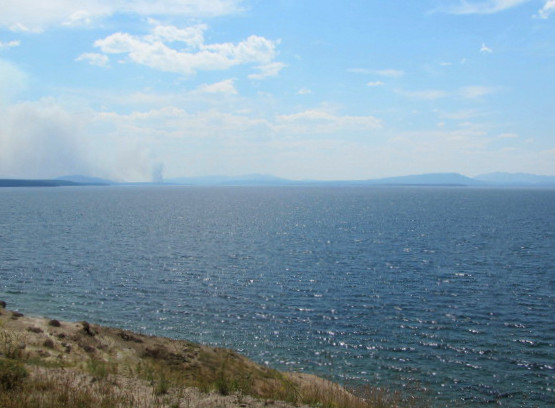
DSC_0017    We stayed two nights within easy walking distance to Yellowstone lake. This allowed two mornings to capture sunrises over the lake’s eastern sky. The haze due to distant forest fires and another east of the lake allowed the sun to explode with reddish hues.
Distant smoke

Distant smoke

Yellowstone River

Yellowstone River

Yellowstone Lake is the largest natural high-elevation lake in the North America. The waters consist of 132 square miles of surface area and 141 miles of shoreline. This is not a small body of water. The depths are around  400 feet.

DSC_0171   Yellowstone is famous for its geysers and hot springs. There is evidence of underwater geysers and hot springs too. Despite the hot springs the lake is frozen over half of the  year.

The Yellowstone River is a part of the lake obviously. This water exits the lake  forming the Grand Canyon of Yellowstone. (A few photos of the canyon were in the #6 entry.) This river is the longest undammed river in the lower 48 states as well.                         IMG_1236

Smoke from closest fire

Smoke from closest fire


Laurie and I were up early the first morning to hike to the lake. Unfortunately, she froze out since the temperatures had reached the upper thirty degree mark overnight.  She elected to head back to the lodge when she saw a small fox-like mammal in her terms. This was a pine marten. (We would see one at the Grand Canyon of Yellowstone the next day.)

IMG_1235  I explored the shores and nearby forests anxious to what was around the next bend. Mergansers and gulls and even pelicans were viewed around these waters. Much to soon, I had to exit this exploration to visit other unique sites.            IMG_1186

The lake is having an issue to deal with. The native specie of trout is called the Cutthroat Trout. It is in decline due to the introduction of the Lake Trout.  The deeper  water Lake Trout feeds on the young Cutthroat Trout of the shallower water. The Cutthroat doesn’t return the favor and the results are obvious. The park service has been hiring commercial fishermen with special nets to remove as many lake trout as they can catch.                                                                      DSC_0028

DSC_0003   I have heard of Yellowstone all of my life. I never expected to actually make a trip to see the United states first national park. The park was established in 1872 and has around 2.2 million acres of, mostly forest and grassy lands. Pines, namely Lodgepole Pines are the dominant specie of evergreens.

New growth

New growth

Just as the Grand Tetons, many species of wildlife make this land their own. Of course, bear and wolves are present here, as well as, bison, elk and mule deer.

Badly burned area

Badly burned area

Chipmunk

Chipmunk

The most well-known river is the Yellowstone River. This waterways flows approximately twenty miles through the park. The Yellowstone Lake is, also, found within the park’s boundaries. (A separate entry will be written on the lake.) 

Falls

Falls

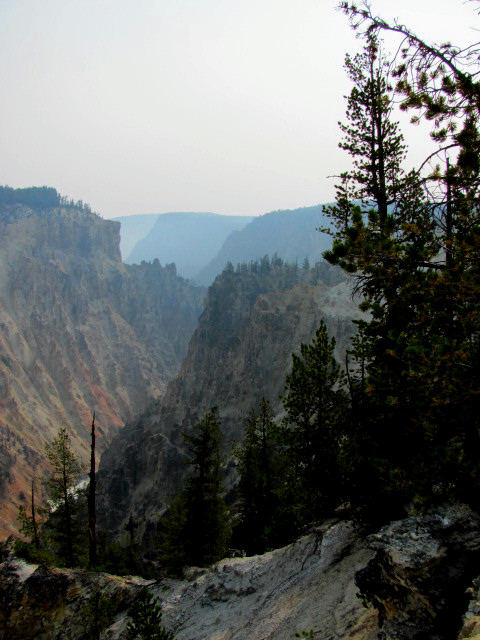
The river yields to some great, scenic views, namely the Grand Canyon of Yellowstone. Two waterfalls are predominate here. The Upper Falls is 109 feet high and the Lower Falls is 308 feet high. They are spectacular to see. The canyon formed by these waters is steep and high with a host of beautiful colors. The colors vary in regards to the how the sun strikes their surfaces. We stood in awe at the breath-taking view!

Coyote

Coyote

Pine Marten

Pine Marten

Laurie and I were walking along a trail when a reddish-brown streak went streaking by. I recognized the mammal immediately as a Pine Marten. The speed and terrain allowed for several quick photos, but none are of the quality I would have liked. the little guy just wouldn’t turn for me! (Laurie saw one earlier near the lodge and said she saw an animal that resembled a small fox. It was a marten.)                                  IMG_1197                          

Grand Canyon of Yellowstone

Grand Canyon of Yellowstone

Natives inhabited this land in times past. the Kiowa; Blackfeet; Crow and Shoshone are better known names. I can imagine these people struggling with the elements of this potentially harsh winter climate. The park shuts down many aspects of the park from around November til May due to the deep snows.

Wyoming state law prohibits getting closer than 25 yards to bison and 100 yards to wolves and bear. I would find myself breaking this law more than once over the two days here. however, all encounters like this were totally by chance and unintentional.                                                                                            IMG_1199

Indian Paintbrush

Indian Paintbrush

Native wild flowers abound in the park. Spring would be wonderful to see I am sure. Several species I found were the Mexican Hat; Wild Lupine and Indian Paintbrush.

The pine forests are dominant as I said earlier. however, many acres were burned at various times. The fire of 1988 burned the most acreage. The remnants of this fire can be witnessed throughout the park with charred limbless trees and downed logs. Over twenty years later a young forest is emerging and growing.

The bear...sorry!

The bear…sorry!

Sunrise

Sunrise

One morning, I exited the lodge at 5:40 to work towards a T-intersection of mixed forest and grassy lands. Yesterday, we had seen some cow elk feeding and I hoped to se a bull early this morning. this intersection was over a mile away.

I eventually entered the woods for a personal experience. I adjusted the camera for some flower photos. I entered the roadway again and walked a short distance when twenty paces ahead and to my right a big black bear emerged from the pine growth. I fumbled for some pics and I was disappointed to get one clear photo. however, the bruin was entering the woods again and my whistles were ignored. The big guy’s head was behind the greens. Oh well, I am including the shot!                                                  DSC_0158

DSC_0123  I, eventually entered the woods again and heard an elk bugling a few hundred yards away. I circled the grassy areas but never say the elk. On my return towards the lodge, I spotted a large bull elk with dangling and bloody velvet on his antlers.

We saw bison, mule deer, pronghorns and a coyote this day.

DSC_0227  What event to view nature could be better that a ten-mile float trip on the Snake River? Fortunately for us, this is not a Class 5 float!!    DSC_0225

Immediately, upon entering the Snake River an eagle was observed. The mature bird was settled on a bluff’s edge with his wings slightly opened to dry off.  The rest of the trip just had to be a good one!

The Snake River consists of clear, cold water favorable to fish species such as the native Cutthroat Trout. Our native trout in Pennsylvania is the Brook trout. Eagles, otters and osprey prey on these trout when opportunity exists. This might be why the eagle was drying out. The bird may have attempted to catch a trout.                                                                              DSC_0281

The float guide knew the waters well as we drifted south. We were all in constant state of alertness for various wildlife species. We wouldn’t be disappointed! In total we saw seven different bald eagles including one immature eagle of the year. the big birds seemed to tolerate us very well.

Pronghorn

Pronghorn

Bald eagles

Bald eagles

We continued on and suddenly we saw a young bull moose. What a thrill this was! Unfortunately, the vegetation did not allow for any quality photos. Fishermen, farther along, reported just seeing a cow elk, but she had disappeared.

Other bird species observed were Common Mergansers, a sandpiper and Canada geese. We saw a raccoon looking for food along the water’s edge. the ‘coon didn’t seem concerned our presence at all.

Bull Moose

Bull Moose

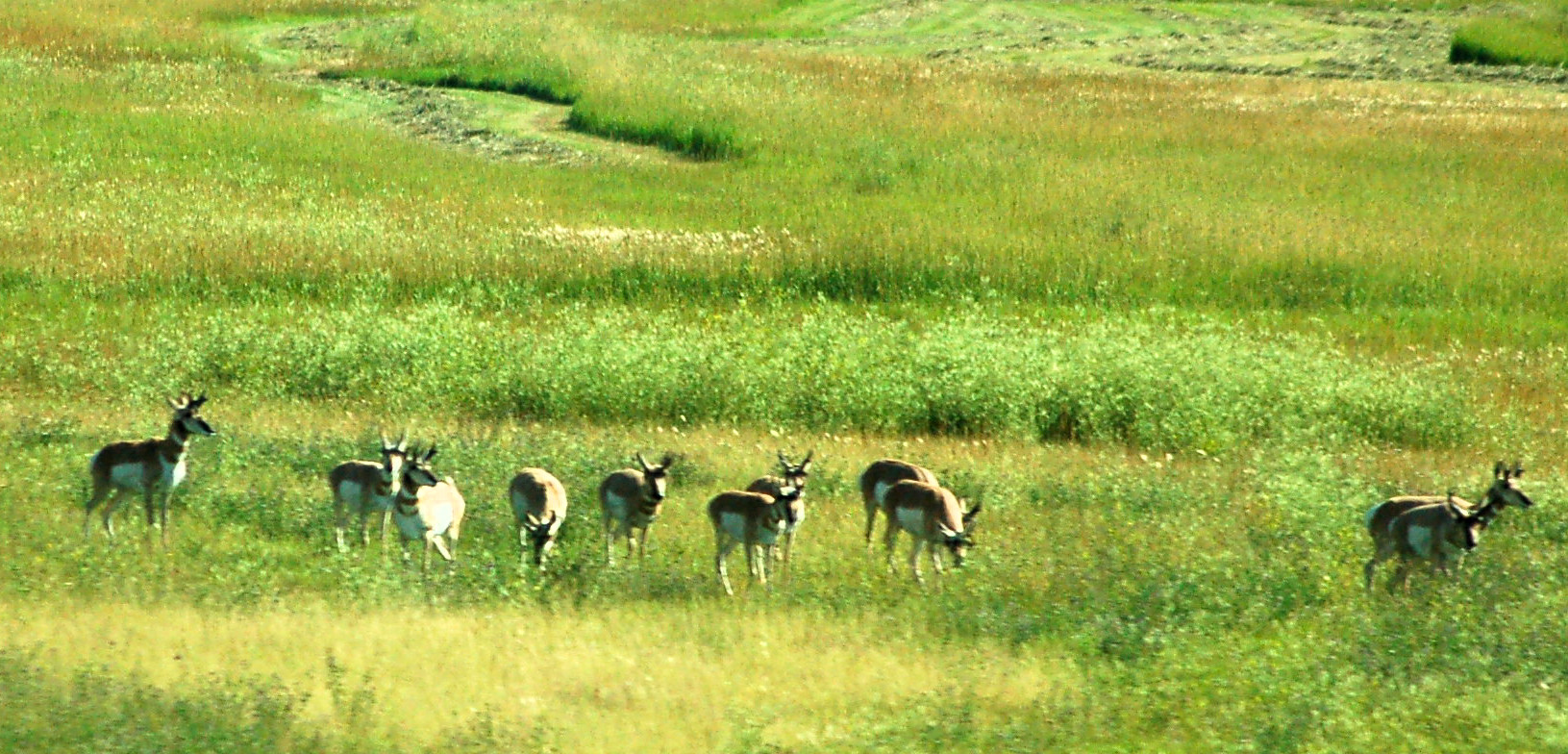
A small heard of pronghorn antelopes  were grazing in the lush grasses. They allowed  several photos.

Immature Eagle

Immature Eagle

DSC_0274 So, with seeing all of these varied species of wildlife with the majestic Grand Tetons contrasting the green pines how could we have asked for anything else!

DSC_0156  The breakfast was completed and the tour north began in earnest. We would soon be witnessing the beauty of the Grand Teton Mountain range! We left the famous Jackson Hole area of western Wyoming.                                    DSC_0160

Jackson, also, known as Jackson Hole  is a tourist community. Everything one sees in geared towards the tourism economy. Those high forested hills that surround the town are stunning too. Looking backwards from where we stayed we could see ski lifts.  Winter is big in this area too!                                                                     DSC_0146

Laurie and I watched as two hand gliders leapt from the top to begin floating about the sky. The evening before we watched a cowboy shoot out.

We were thrilled once the sight of the Grand Tetons was visible! We were in unbelief upon viewing the spectacular mountains. We found taking our eyes off of them to be difficult. Photos just can not show the grandeur of such things of nature! The only negative thing, I can think of,  was the fact of a slight haze due to distant forest fires. Many fires were west of us in nearby Idaho. The haze reminded me of a humid condition here in good old Pennsylvania.                                                          IMG_1158

The 310,00 acre national park was established in 1929. (I was just a boy then.) The park’s size was increased in 1950. The highest elevation is of the Grand Teton mountain at 13,770 feet. Snow from last winter, and spring, was still visible at certain places amid the rocky outcrops.                                IMG_1167

Chapel of the Transfiguration

Chapel of the Transfiguration

Other named peaks include: Mount Moran at 12,605 feet; Mount Owen at 12, 928 and South Teton at 12, 514 feet. People do climb the mountains and injuries are common, as well as, some deaths. Trails exist on and around the peaks too.

Raven (note large beak)

Raven (note large beak)

The clear waters of the Snake River flow through the lands. Several lakes are present too. We saw Jackson Lake and Jenny lake. (More on the Snake River under a separate entry.)

Many species of wildlife are present in the Grand Teton area. We saw a lot of wildlife while touring and floating the Snake River.

Aspens

Aspens

Bison!

Bison!

We saw a number of bison (buffalo) in open areas. Someone shouted “BEAR” and we turned to get a brief glimpse of a young grizzly bear! Ravens were common. I was tolerated by one. I managed a few great shots of this raven. Other species in the area are elk and mule deer. I saw a Mountain Bluebird and, of course some pronghorn antelopes. I saw both of these species. Wolves are surviving here too. I would have loved to see some wolves!                                             DSC_0180

Bison will cause more injuries than any other species of wildlife here. It is no wonder! I saw some people try to get very close. These people would NOT have been able to escape if these big mammals decided to charge. State law forbids anyone from getting closer than 25 yards. We were told of one lady who was told to get back from bison because of the potential danger. She became angered exclaiming how dare they allow dangerous animals in the park….. DUH!! These are wild animals not a zoo! Other interesting sites included a small log church known as the Chapel of the Transfiguration. (In fact a wedding was occurring at this church.)  We visited a small rural old-fashioned store. I bought some huckleberry honey! We saw remnants of an old ferry known as Menor’s Ferry.      DSC_0247

Much of this area close down by mid-November due to snow. the snow may be present into May and even early June.

IMG_1162

IMG_1143  The vast prairie lands are visible in a 360 degree field of view. All directions are covered with the pale-blue sage brush and white-colored rocks and ground. The sight is magnificent to behold to a couple of easterners. The sage sends down deep tap roots and then lesser roots parallel to the surface. Some of these plants may be over a hundred years old.

Close-up of a sage specie

Close-up of a sage specie

IMG_1140

The trail is now headin’ north as we approach the area known as Jackson Hole. The unbelievable mileage of flat sage-covered land is mind-boggling.   We did see a couple of Prairie Falcons and more antelopes.

Wild horses in a corral.

Wild horses in a corral.

Wild Horses

Wild Horses

In this area of Wyoming are living wild horses. The location is north of the community of Rock Springs, The buttes and vistas are home for approximately 2500 wild horses. A thriving population is surviving on these barren lands. Those in the know make claims the horses grow by 20% and up to 40 % annually. Reproduction is, apparently, going well for the horses.

Prickly Pear Cactus (Note insects)

Prickly Pear Cactus (Note insects)

With that in mind a number of wild horses are taken into corrals periodically in an effort to maintain a stable herd number. We stopped at one such corral.

The horses are placed up for adoption while in captivity.                                                                              DSC_0031

IMG_1146  Eventually, as we continued north, we began to see higher terrain again and some steep and grandeur mountains were present prior to our descending into Jackson Hole. The hollow featured clear mountain waters flowing towards the Snake River. I was blessed to briefly see a Bighorn Sheep ram. The ram was a younger one since he lacked the full-curl horns.    DSC_0038

DSC_0059   The terrain changes rapidly in many areas of our travels. We are seeing lush farm country lands of Nebraska and suddenly we are witnessing prairie lands pale blue with sage brush and rocky outcrops. This day brought about our first view of the “true west” country.

The place we stayed in Cheyenne

The place we stayed in Cheyenne

DSC_0117

We stayed in Cheyenne, Wyoming and later moved through Laramie. Obviously, I remember these names from western history and old western television shows.                                        DSC_0080

DSC_0096 In southern Wyoming steep hills become more prevalent in certain areas. These were the Laramie Mountain ranges of the Medicine Bow National Forest. We were impressed with their stature, but the mountains of our future would dwarf these ridges.

Big Sky

Big Sky

We traveled across this area when suddenly we emerge in a vast basin going on for miles. We were impressed! The sage country was now in full view. We were in a very unique and beautiful land.

A sage

A sage

The very common sages are unique plants. They tend to have a pale bluish hue. The plants have a remarkable and pleasant aroma when rubbed between the fingers. Sage was used by the Indians and early settlers as a deodorizer. These people might rub some on their bodies and place in their abodes to help as a freshener.     DSC_0077

Blue Prairie Flax

Blue Prairie Flax

We stopped at a visitor center or two. I noticed a small, pale “groundhog-like” mammal. They were known locally as a pocket gopher. The correct name is Uinta Ground squirrel. Laurie was fascinated with them and we managed to get close enough to observe them and take  photos. They were cute little rascals, but by the amount of ground piled up I could see they could be damaging to property.

Uinta Ground squirrel

Uinta Ground squirrel

Sage brush was very common by this time of our travels. Miles of the plants were everywhere. This was a strange beauty. Pronghorn antelopes became routine. We saw hundreds of them. Most would be over two hundred yards from the roads with few exceptions.

DSC_0101

Pronghorn Antelopes

Pronghorn Antelopes

DSC_0006   Westward Ho the Wagons was a 1956 film  depicting pioneers heading west during the difficult and dangerous times after the Civil war.  Laurie and I heard the words “Go West Young Man”. These were words accredited to Horace Greeley after that great war.

Hundreds of windmills are located in the flatter states.

Hundreds of windmills are located in the flatter states.

We began our western journey on August 11 during the wee hours of the morning. The western migration had begun with many planned destinations in store for us weary pilgrims. The wagon axles were greased and the horses strong!

DSC_0010  The areas we were to visit included such, well-known, places as Jackson Hole; the Grand Tetons; Yellowstone; the Black Hills; the Badlands and many other interesting and enjoyable events. We saw a rodeo in Cody, Wyoming; a wild horse area; museums and much of western America’s varied and diversified lands.                                              IMG_1534

(I will be including many entries of this trip over time with many photos since I have taken , at last, count 1049 photos. They will be titled and numbered. This, of course is number 1.)                  

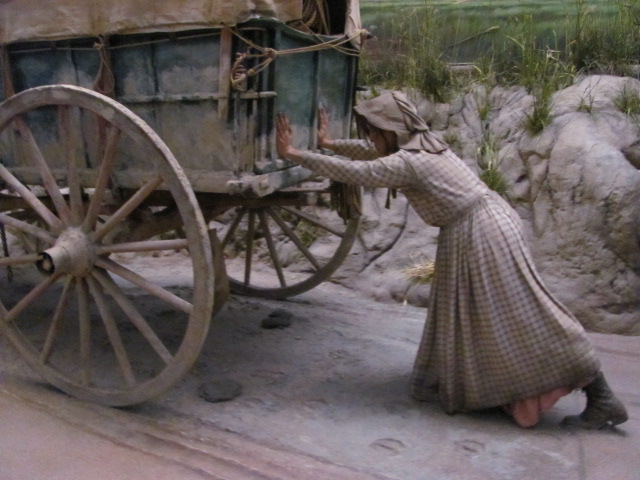
A hard and difficult way of life!

A hard and difficult way of life!

Early pioneers with Conestoga wagon.

Early pioneers with Conestoga wagon.

The reason for this excursion came about after much discussion. We are seeing much uncertainties with the health bill that was passed. We, too, are uncertain of our health insurance’s status in the years to come. We have, already, since increases and changes with Laurie’s plan. We decided “the heck with it” and elected to move out!

The travel through the states of Ohio and Indiana into Illinois were the “Agricultural flatlands” of the first day. Of course, this terrain is not what I am used to seeing. The contrast is stark from my beloved Pennsylvania hills and hollows. Yet, despite this variance they land is still beautiful.

DSC_0015      We settled in the first evening at Peru, Illinois. The following morning we visited “Boy’s Town” in Omaha, Nebraska. We toured the magnificent church and Father Edward Flanagan’s home and other sites. Spencer Tracy and Mickey Rooney starred in a film of the same name in 1938. The home was started by the father to aid delinquent and underprivileged boys. The intent was to correct these boys and make them into productive citizens. The web site is: www.boystown.org

The trail continued throughout Nebraska. All I can say about Nebraska is CORN AND MORE CORN! Corn, and other crops, could be viewed for as far as the eye can see. Hundreds of acres of agricultural crops!  One can realize why the mid-west states are called the “Breadbasket of America.”                                                                                                          

Great Platte River Archway

Great Platte River Archway

Mountain man searching for a woman.

Mountain man searching for a woman.

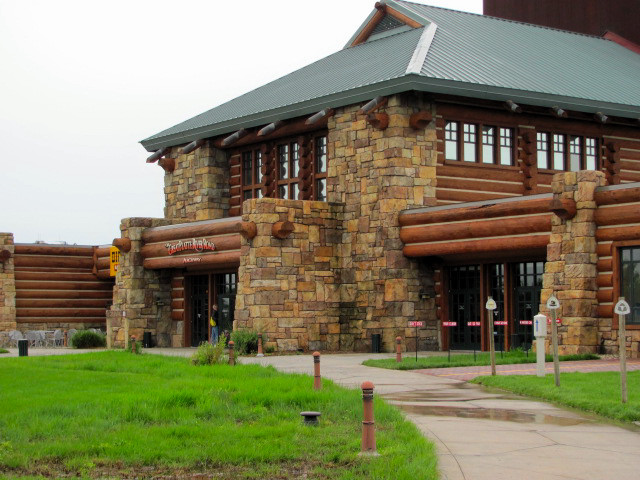
We, also, stopped at the award-winning, Great Platte River Archway Monument. This construction completely covers Interstate 80 and has many exhibits of history of the early pioneer days through the more modern era. This is in regards to Highway 30 or the Lincoln Highway. This year is the 100th anniversary of the Lincoln Highway. This road travels through most of Pennsylvania too.

Other items of interest here were a stream filled with hungry carp and a ground-covered abode of Native Americans from time’s past.                 DSC_0019

We settled in for the night  in Cheyenne, Wyoming.

Horse with wings found on entrances of the archway.

Horse with wings found on entrances of the archway.

Beautiful Morning

DSC_0001  We, here in western Pennsylvania, have been witnessing some great summer weather. The morning temperatures are in the fifty degree comforts. I, and sometimes Laurie, have walked about a half a dozen times in the last two weeks. How could I be expected to set and paint or work on a precious day like this.   DSC_0012

I needed to visit my sister this morning so the walk was planned early and near her residence. I elected to walk the Frog Pond Road near the Simpson Church. (This church was built in 1893.) I believe this area still to be in Cowanshannock Township.                                   DSC_0004

Two fawns.

Two fawns.

The early morning held a fairly thick fog, but the sun in short order began to burn the fog off. I saw a number of rabbits and a couple of gray squirrels. I saw eleven deer  in total, four of which were fawns. I was blessed to watch them play and case each other. I saw two flocks of turkeys. One flock yielded a few poults to my view. The other flock, probably, had some babies, but the high vegetation would not allow seeing any.                                           DSC_0003

The round-trip venture was around four miles possibly a little more. The morning was quiet and comfortable and not one vehicle came past me while walking along the road. This is a rare treat!

Red (Purple) Clover

Red (Purple) Clover


Joe-Pye

Joe-Pye

This week was different from the past few. The temperatures have been becoming much more pleasant. I have walked three different mornings this week to enjoy the greatness of nature.

Butterfly Weed (Flower)

Butterfly Weed (Flower)

Last Monday, however, I went Lock 8 on the Allegheny River to try my luck at some fishing. I failed to catch any fish during the couple of hours attempting to do so. I became snagged with the very first cast and that event seemed to set the mode for the rest of this trip. I was snagged many times and lost my riggings up to eight times. I missed one fish and hooked another but the size and, possibly, the specie either broke or bit the line. I saw three deer and a heron this morning.

Filtered light along Cowanshannock Creek

Filtered light along Cowanshannock Creek

I was to visit my sister on Wednesday morning, so I planned a walk along Red Mill Run and the mouth of Cowanshannock since she lives near this area. The cool comfortable early hour was great for walking. I saw four buck at one time. I failed to capture any with photos. There was lots of foliage around the four deer and the photos I managed to take were of little value.. A stray cat followed me around for a little time. I always hate to see dogs and cats dropped off to fend for themselves.

Thursday morning I walked a couple of miles near my homestead prior to visiting my family. The early time was cool enough that I was forced to roll my sleeves down. Later, I saw a buck walking the creek bottom. I managed a couple of pics.   IMG_1106

Friday morning I walked along Buffalo Creek in the Yellow Dog area  of Armstrong County. This was, mostly a road walk. I saw a great blue heron a few times and two wood ducks around the water source. I, also, saw a few decent sized carp within the slow-moving creek.  I debated whether to go carp fishing.

Buffalo Creek

Buffalo Creek


A hint of blue sky!

A hint of blue sky!

The temperatures and humidity are to be leaning way towards the hot end of the spectrum all of this week. I decided late last evening that I needed to get out and catch a few fish early in the morning prior to these conditions being met.

Same view after the fog!

Same view after the fog!

I was on the road towards Lock Number 8 on the Allegheny River shortly after 6 A.M. I had a lot of worms that wanted to be fished with. I obliged them all!

A nice doe crossed the road just prior to the dam’s entrance. I slowed down watching for any small spotted offspring that may be following her.

The river was engulfed in fog until the sun lifted high enough to cause evaporation of the water molecules. I witnessed a great blue heron soaring low across the river in the fog. The long-legged bird landed down river from my fishing site.

Bee-Balm!

Bee-Balm!

Along the river’s shoreline are millions of minnows or shiners. The fish chased them continually until about 8:30 A.M. The little two-inch long fish would leap out of the water upon being chased by larger predatory fish. They appeared to be bass.  I hoped I wasn’t seeing those Asiatic (Flying) carp taking hold in these waters. All morning long I would see fish jumping in the waters. I saw carp and a muskie. I saw a large fish that I believed to be a gar. The scales indicated such a fish for sure. The fast-moving water clouded with murkiness made a positive ID difficult. However, later I saw the fish in its entirety. It was, indeed, a gar and the length was around the forty inch mark! I had some other gar sightings too, but these were in the 28 to 32 inch length category.

Phylox

Phylox

I was blessed with catching four smallmouth bass. The lengths ranged from about eleven inches to fifteen inches. These all supplied some fighting abilities on light tackle. I lost several and missed several too.

The time reached 9:15 and the heat was becoming prominent. I decided the time to head home was nigh. I have paintings and recordings to work on!